Across Cohere Commerce retailer feedback from Sprouts, Whole Foods, Vitamin Shoppe, Clean Market, and specialty wellness stores, the mushroom category is showing a clear maturation curve: from curiosity-led adoption to execution-led retail performance.
Growth has steadily normalized:
- 2024: ~55% YoY (early discovery, novelty-driven trial)
- 2025: ~35% YoY (distribution expansion, emerging use cases)
- 2026: ~20% YoY (mature category, repeat + shelf execution driven)
What’s changed is not demand, but the mechanism of growth. Mushrooms are no longer scaling because they are new—they are scaling based on how well they convert and retain.
2024–2025: Discovery Phase (Education-Limited Growth)

Early retailer feedback shows a category driven almost entirely by curiosity, not clarity.
Consumers were interested, but unsure what mushrooms actually did in a functional context.
Common retail signals:
- High trial, low understanding at point of purchase
- Strong dependence on staff explanation and sampling
- Packaging and shelf placement often outperforming formulation in driving conversion
- Frequent comparisons to adjacent categories (CBD, kombucha, energy drinks, adaptogens) rather than direct competition
A consistent friction point was price without perceived certainty of outcome.
“People don’t want to spend that much and not like it.”
What this phase actually meant
This was not a demand problem—it was a translation problem.
Mushrooms existed as a concept before they existed as a clearly defined retail category.
2025–Early 2026: Category Structuring (From “Mushrooms” to Use Cases)

By 2025, the category stops behaving like a single segment and starts splitting into functional lanes. This is the first sign of real category formation.
Three structural shifts emerge:
1. Energy becomes the primary acquisition engine
Energy-focused mushroom products begin outperforming broader wellness positioning.
Retailers increasingly describe direct comparisons to mainstream energy:
- Coffee alternatives
- Energy drinks (Celsius, Red Bull, Monster)
- Morning focus routines
Key insight:
Mushrooms stop being “alternative wellness” and start competing in mainstream functional energy sets.
This is a critical inflection point: it shifts the category from niche wellness into mass consumption adjacency.
2. Calm and sleep become the repeat backbone
While energy drives discovery, calm and sleep drive retention.
Gummies consistently outperform beverages in this segment due to:
- Lower sensory friction (taste is less critical)
- Easier habitual use (night routines)
- Lower cognitive load (“take before bed” vs. “use like a drink”)
Retailers repeatedly note:
- Stronger repeat purchase behavior vs RTDs
- Higher reorder consistency
- Easier staff recommendation scripts
Key insight:
Calm products are not the growth engine—they are the retention engine.
3. Gummies emerge as the “conversion layer”

Across retailers, gummies repeatedly outperform other formats in consistency, even when beverages generate more visibility.
Why:
- No flavor barrier
- Lower trial hesitation
- Easier first-time adoption
- Less comparison to competing beverage categories
This creates a split structure in the category:
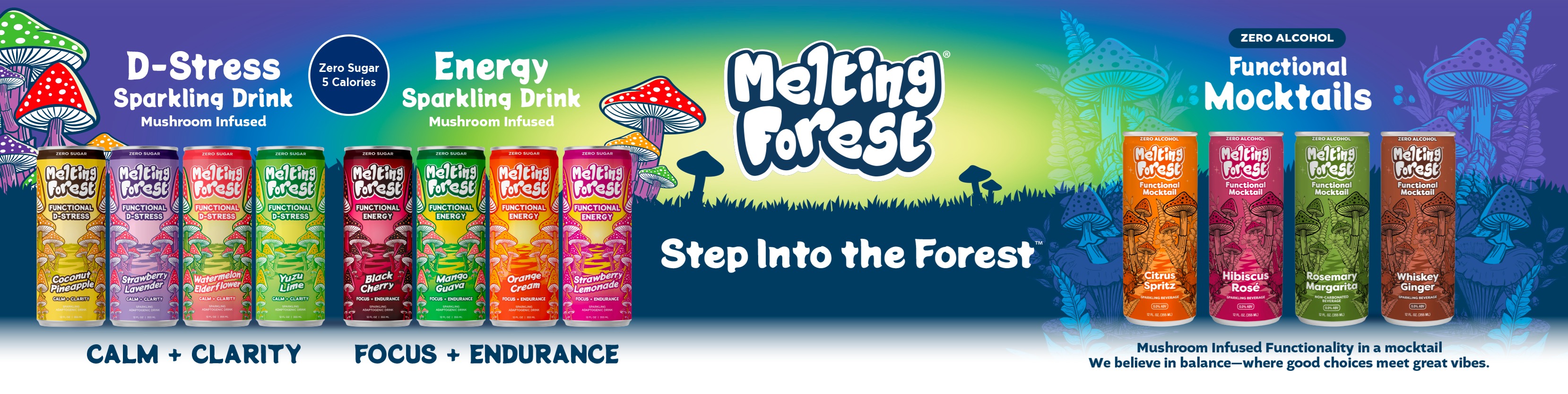
- Beverages = discovery + impulse
- Gummies = habit formation + repeat purchase
4. Flavor becomes a hidden performance driver

By this stage, retailers consistently highlight flavor as a determinant of repeat sales, not just trial.
Notably:
- Functional benefits drive first purchase
- Flavor determines whether the second purchase happens
This explains why products with similar formulations often diverge sharply in velocity across stores.
2026: Category Maturity (Execution Becomes the Growth Driver)
By 2026, the category stabilizes at ~20% YoY growth. This slowdown is not weakness—it is maturation.
Retailers are no longer asking:
- “Do mushrooms sell?”
They are asking:
- “Why does this store sell them better than another?”
Key structural changes:
1. Awareness is no longer the constraint
Most shoppers now have baseline familiarity with mushroom benefits. The barrier has shifted from education → conversion efficiency.
2. Repeat purchase is the primary growth lever
Category performance is increasingly defined by:
- Taste consistency
- Clear use-case alignment
- Habit formation (sleep, morning focus, recovery)
- Out-of-stock management
3. Execution gaps now explain most performance differences
Retail feedback increasingly points to operational factors:
- Sampling availability
- Shelf clarity
- Stock reliability
- Packaging communication of function
The same product can behave like a top performer in one store and a slow mover in another purely based on execution conditions.
Cross-Year Evolution (What Actually Changed)
2024
Curiosity-led expansion
- “What is this?”
- Trial-heavy, education-dependent
- High variability across stores
2025
Use-case structuring
- Energy, calm, sleep begin separating
- Gummies emerge as dominant entry point
- Brand differentiation starts mattering
2026
Execution-led performance
- Awareness is stable

_910ca2_.png)